Yellowstone National Park
Yellowstone National Park
Just got back from three days at Yellowstone and I’m still thinking about it. Something about that place stays with you.
Getting There
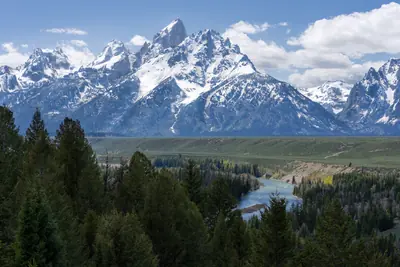
We flew into Jackson Hole on Saturday around lunchtime. The airport sits right at the base of the Tetons, which is pretty spectacular if you’ve never seen it before. Grabbed supplies in town and started the drive north to our hotel at Lake Yellowstone. The whole drive up, elk and bison everywhere. Just standing there by the road like it was the most normal thing in the world. I guess for them it is.
Yellowstone became the world’s first national park back in 1872, signed into law by President Ulysses S. Grant. Before that, the area was home to Indigenous peoples for more than 11,000 years. The Crow, Shoshone, Bannock, and other tribes traveled through these lands long before any explorer set foot here. When the park was established, those tribes were forcibly removed. It’s something worth remembering when you visit.
The Volcanic Heart
The whole park sits on top of a supervolcano. That’s not an exaggeration. The Yellowstone Caldera is one of the largest active volcanic systems on Earth, measuring about 30 by 45 miles across. It’s had three major eruptions over the past 2.1 million years. The last one happened 640,000 years ago and was roughly 1,000 times more powerful than the 1980 Mount St. Helens eruption.
You can see evidence of all that volcanic activity everywhere. Geysers, hot springs, mud pots, fumaroles. Over 10,000 hydrothermal features in the park, which is more than anywhere else on the planet. The ground is literally boiling beneath you in places. We saw dozens of these features driving around, steam rising from the earth like something out of another world.
Artists Point and the Grand Canyon
One afternoon we drove to the Grand Canyon of the Yellowstone. Not the Grand Canyon, but still absolutely worth it. The Yellowstone River carved this canyon over thousands of years, cutting through volcanic rock to create something stunning. The canyon is about 20 miles long and up to 1,200 feet deep in places.
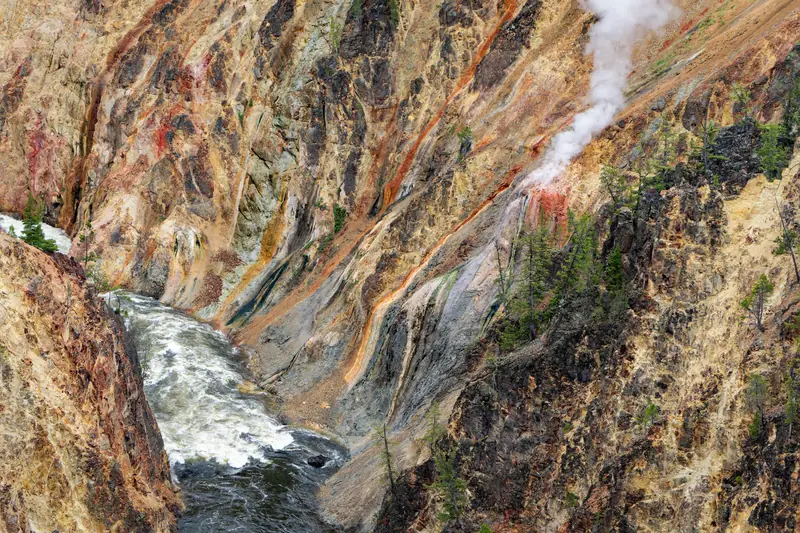 Grand Canyon of the Yellowstone
We stopped at Artists Point, named because it supposedly offers the perfect vantage point for painters. Thomas Moran painted his famous watercolor of the Lower Falls from somewhere near here back in 1872. That painting actually helped convince Congress to make Yellowstone a national park. Standing there looking at those falls dropping 308 feet into the canyon, I could see why it made an impression.
Dinner Near Old Faithful
We ate dinner one night at the Old Faithful area. Didn’t actually see the geyser go off, which was a bit disappointing, but the food was good. Old Faithful was named back in 1870 during the Washburn Expedition because of how predictably it erupts. These days it goes off roughly every 90 minutes, give or take. It shoots between 3,700 and 8,400 gallons of boiling water up to 180 feet in the air each time.
The geyser sits in the Upper Geyser Basin, which has the highest concentration of geysers anywhere in the world. More than 150 of them in just one square mile. The whole basin is part of that massive volcanic system I mentioned earlier.
An Osprey at Grand Prismatic
Drove out to Grand Prismatic Spring the next day. It’s the largest hot spring in the United States and the third largest in the world, about 370 feet across. The colors come from bacteria that live in the water at different temperatures. Blues and greens in the center where it’s too hot for most life, then oranges and reds around the edges where the heat-loving microbes thrive.
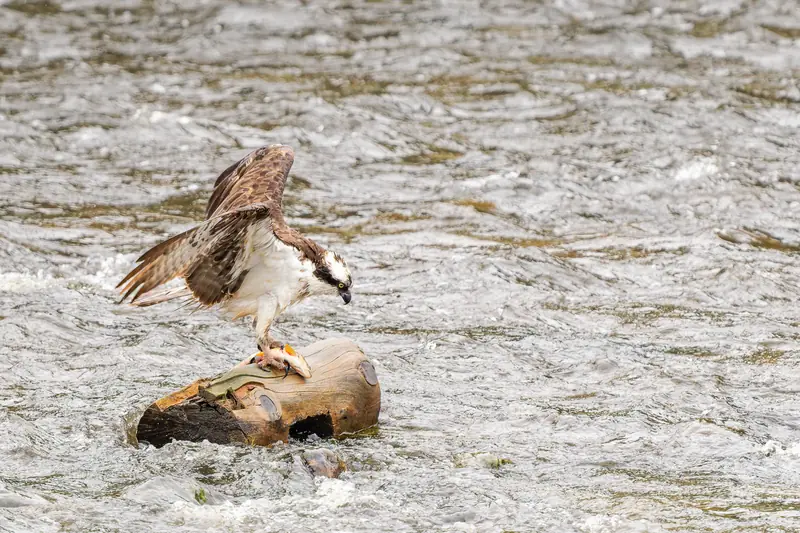 Osprey with a Fish
While we were there, an osprey flew overhead with a fish in its talons. Just grabbed it right out of one of the nearby rivers. Ospreys are incredible fishers. They dive feet-first into the water and can close their nostrils to keep water out. Their outer toe is reversible, which helps them grip slippery fish with two toes in front and two in back. This one looked pretty pleased with itself.
The Grizzly
Saw a grizzly bear while driving the Grand Loop. Just off the side of the road, doing its thing. Everyone stopped their cars. Rangers were there making sure people kept their distance, which is good because grizzlies are not something you want to mess with.
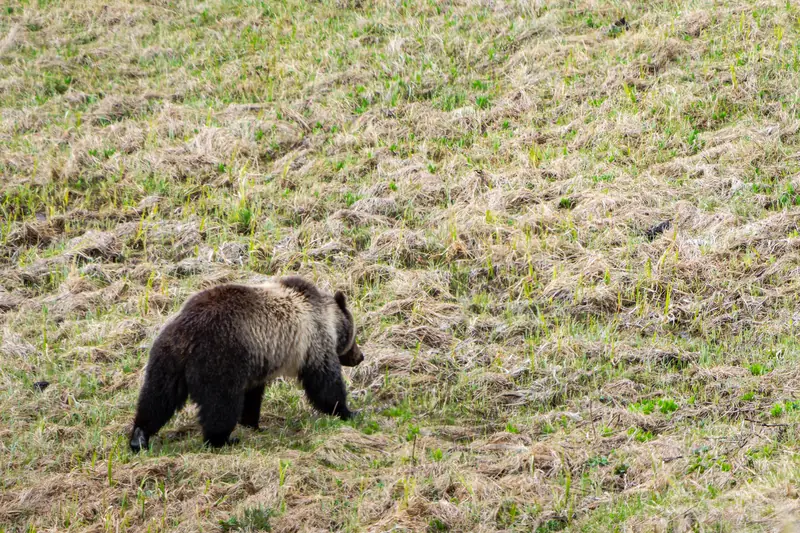 North American Brown Bear
Grizzlies were nearly extinct in the Lower 48 by the 1970s. Yellowstone had maybe 136 bears left in the entire ecosystem. They were listed as threatened under the Endangered Species Act in 1975. Now there are around 1,000 in the Greater Yellowstone Ecosystem. It’s one of the great conservation success stories.
These bears can weigh up to 700 pounds and run 35 miles per hour. They have a bite force of around 1,160 PSI, which is enough to crush a bowling ball. Watching one from the safety of the car, you remember real quick that humans are not actually the top of the food chain out here.
Snow in May
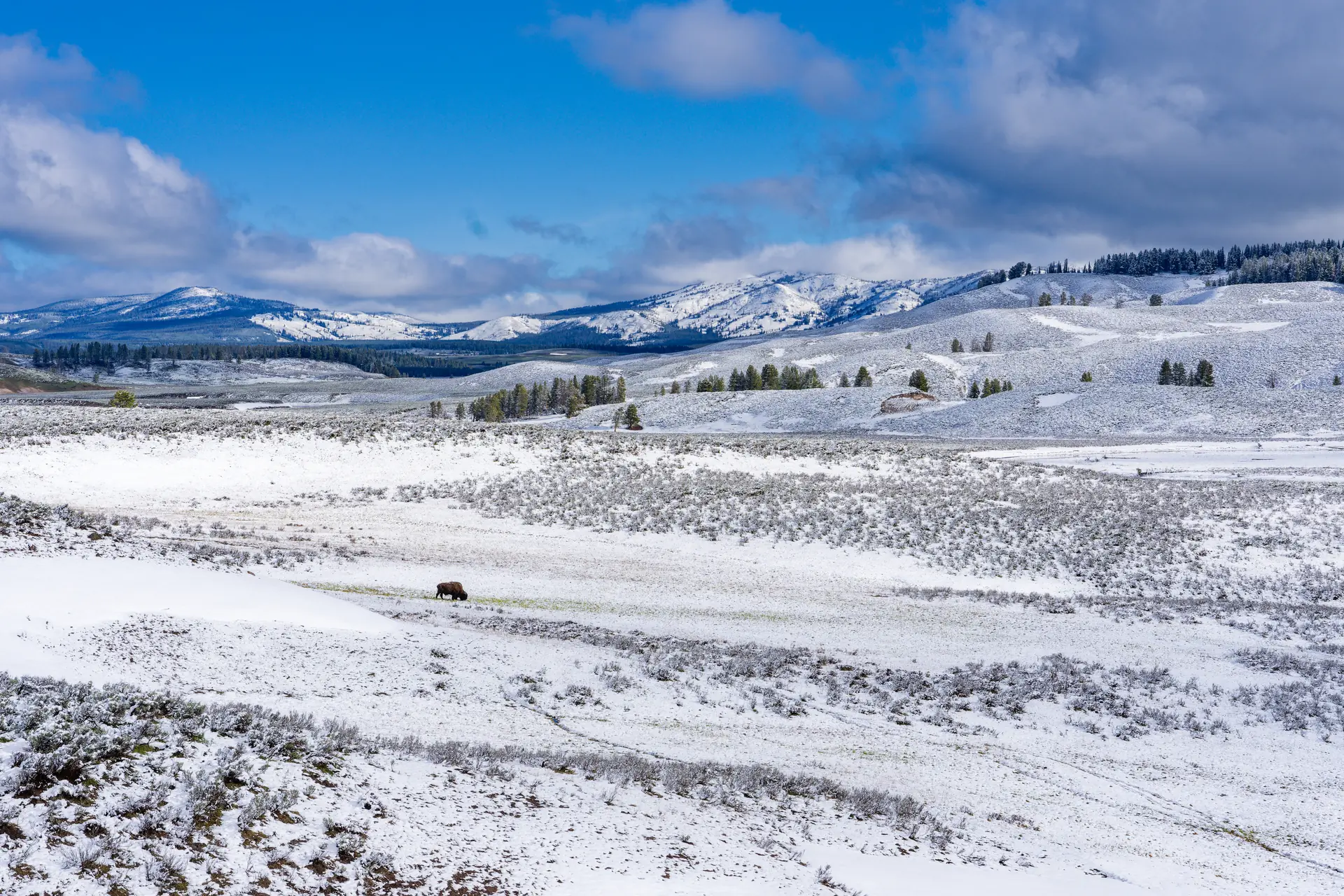
It snowed one of the days we were there. In late May. The weather in Yellowstone is famously unpredictable because of the elevation. Most of the park sits above 7,500 feet. We’re staying at the Lake Yellowstone Hotel, which is right on the shore of Yellowstone Lake at 7,733 feet.
The lake itself is massive. It’s the largest high-elevation lake in North America, covering 136 square miles. The water is cold year-round, usually between 40 and 50 degrees Fahrenheit. Even in summer you wouldn’t want to swim in it for long.
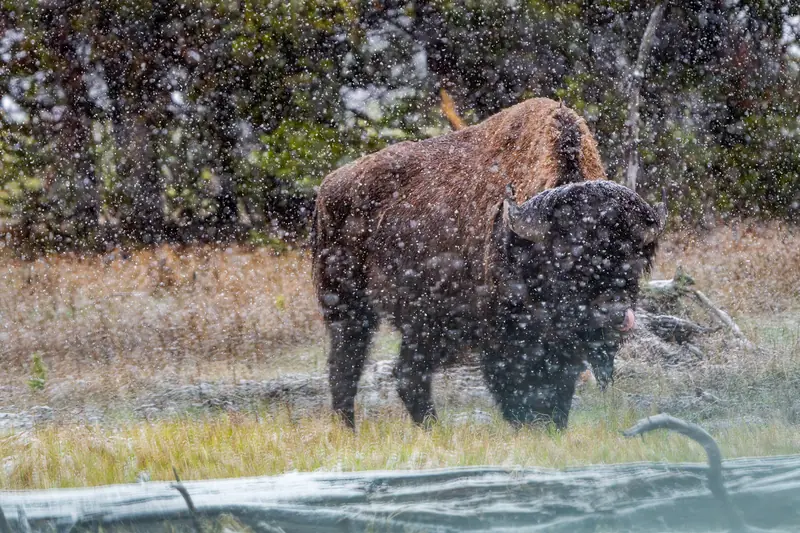 American Bison
Took a picture of a bison in the snow near the hotel. They don’t seem to mind the weather at all. Bison have been in North America for about 200,000 years. By the late 1800s, they were nearly wiped out. There were maybe 25 million bison on the continent before Europeans arrived. By 1902, fewer than 100 remained in Yellowstone. Now there are around 5,000 in the park. They’re the only place in the U.S. where bison have lived continuously since prehistoric times.
Dunraven Pass Closed
We wanted to drive through Dunraven Pass but it was still closed. The pass tops out at 8,859 feet and usually doesn’t open until late May or early June because of snow. It’s one of the highest roads in the park and offers great views of Mount Washburn, but we’ll have to see it another time.
Mammoth Hot Springs and Lamar Valley
Spent one day driving up to Mammoth Hot Springs. The terraces there are made of travertine, which forms when hot water dissolves limestone deep underground and then deposits it on the surface as it cools. The formations grow about an inch per year in some places. The terraces have been forming for thousands of years.
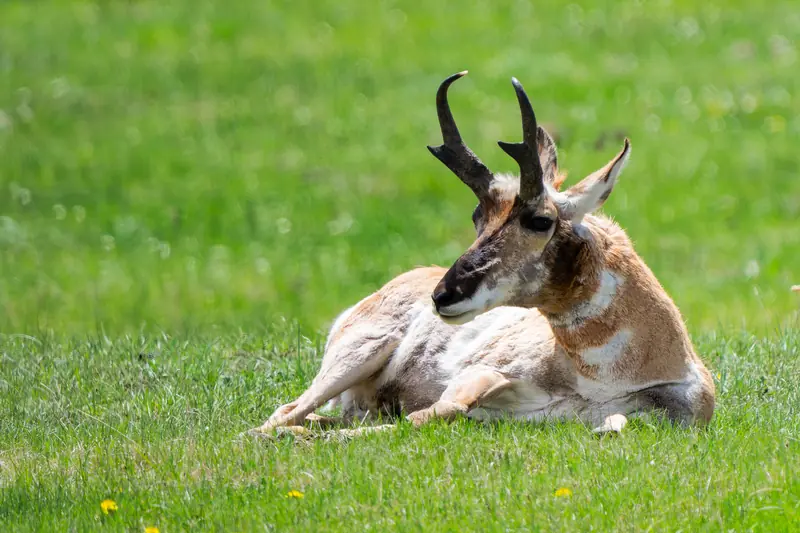 Pronghorn
On the drive through Lamar Valley we saw more bison and this pronghorn. Lamar Valley is sometimes called the Serengeti of North America because of all the wildlife. Pronghorns are the fastest land animals in North America, capable of running up to 60 miles per hour. They’re not actually antelopes, even though people call them that. They’re the only surviving members of the family Antilocapridae. Their ancestors evolved here millions of years ago.
Pronghorns have the largest eyes of any animal their size. They can see movement up to four miles away. Made sense when you think about predators on the open plains. They also have hollow hair that provides insulation. Pretty well adapted for this environment.
Breakfast at Lake Lodge
We ate breakfast every morning at Lake Lodge, which is just a short walk from where we stayed. Good food, nice and quiet in the mornings before the crowds showed up. There’s something about starting the day like that, looking out at the lake with coffee and a hot meal, knowing you’re about to see things most people only see in photos.
Until Next Time
Three days wasn’t enough. I know that now. There’s so much more to see.
But that’s all right. Gives me a reason to come back. Already thinking about when we can make it happen again.